

By 2026, artificial intelligence has turned product rendering from a specialist craft into a scalable, commerce‑ready pipeline. What once required studio time, physical samples, and weeks of post‑production now happens in minutes: AI automates modeling, materials, lighting, and multi‑channel exports so teams can produce photoreal visuals, AR assets, and 360° experiences at scale. The result is faster launches, richer personalization, lower production costs, and measurable reductions in returns across e‑commerce, manufacturing, and marketing.
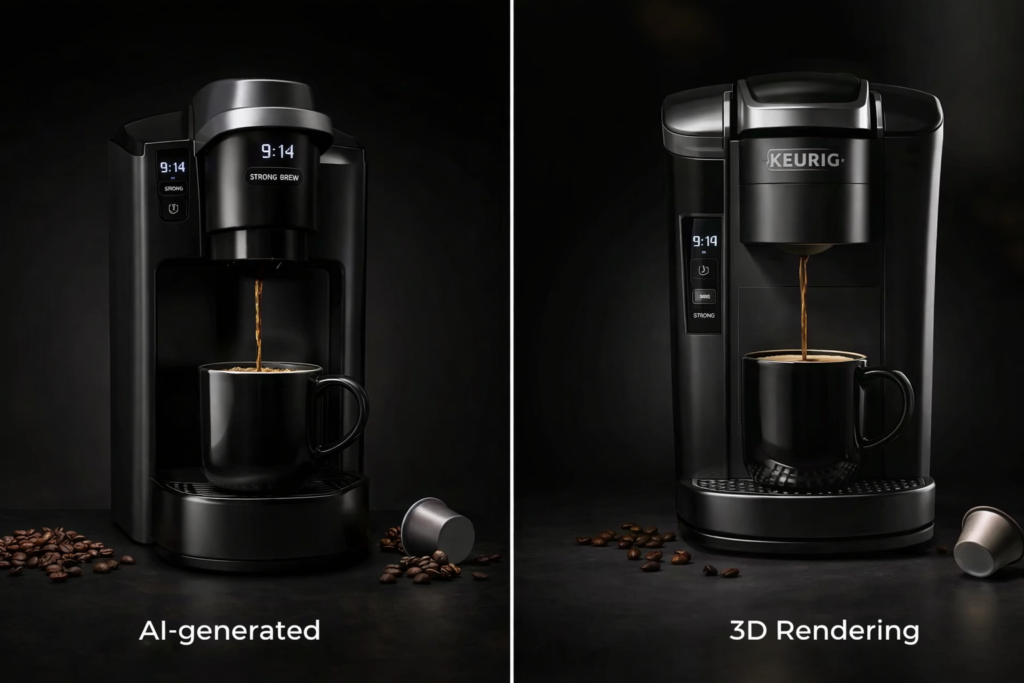
Automation and Speed
AI now handles the repetitive, technical parts of rendering end‑to‑end. Generative models convert sketches, CAD, or a single 3D scan into finished assets, automatically generating UVs, PBR materials, LODs, and optimized geometry. Lighting engines driven by learned scene priors pick camera angles and illumination that match brand presets, eliminating manual trial and error. Batch pipelines produce hundreds of SKU variants—colors, trims, and textures—without additional photography, reducing turnaround from day to minute.
Operationally, this means:
- Automated pipelines: ingest CAD/scan → auto‑retopology → material synthesis → render presets → export to web/AR formats.
- Parallelization: cloud farms render thousands of permutations concurrently, enabling same‑day catalog updates.
- Template prompts: brand‑level prompt templates ensure consistent output across categories and vendors.
Key metrics teams track include time per SKU, cost per asset, variant throughput, and render fidelity score against a photographic baseline.
Photorealism and Material Intelligence
Material creation has become algorithmic and physically informed. Neural networks trained on vast material libraries synthesize convincing wood grains, fabrics, ceramics, and metallic finishes while preserving physical plausibility. Texture synthesis and microdetail generation deliver renders indistinguishable from studio photography, and AI‑driven denoising and super‑resolution make high‑quality outputs feasible on commodity hardware.

Practical benefits and techniques:
- Material transfer: Make a photographed swatch to a PBR material automatically, preserving scale and anisotropy.
- Microdetail layering procedural micro‑normal and roughness layers add tactile realism without heavy geometry.
- Visual to manufacturing feedback: renders include manufacturability flags (seam visibility, tolerance issues) to reduce surprises in production.
These advances let design and production teams validate aesthetics and tolerances virtually, cutting physical prototyping cycles.
Real‑Time and Immersive Experiences
Real‑time rendering and AR product visualization are mainstream commerce channels. Lightweight, optimized assets export directly to USDZ and glTF for mobile AR, while cloud‑rendered scenes stream interactive product configurators to web and apps. Customers can place a product in their environment, toggle finishes, and view behavior under different lighting in real time, turning product pages into immersive decision tools.
Implementation best practices:
- Progressive LODs: deliver high‑fidelity assets for configurators and lower LODs for mobile AR to balance quality and performance.
- Server‑side streaming: stream photoreal visuals to low‑power devices while keeping heavy computing in the cloud.
- Composable configurators: modular asset systems let marketing assemble hero shots, lifestyle scenes, and 360 spins from the same source files.
Service offerings from a modern product rendering studio often bundle AI Image Generation and AI video Generation to produce hero imagery, 360 spins, and short product videos from the same asset set—enabling an AI product shoot without a physical studio.
Business Impact and Governance
The commercial effects are tangible. E‑commerce teams launch catalogs faster and at lower cost, enabling dynamic personalization—render variants tailored to user preferences or regional trends. Marketing gains consistent omnichannel visuals without repeated photoshoots. Manufacturers shorten development cycles by validating aesthetics and tolerances virtually. Across the board, brands see improved conversion and fewer returns because product visuals better match the delivered item.
Governance must keep pace. Key governance elements:
- Provenance logs: record model, dataset, and prompt metadata for each asset to prove commercial safety.
- IP and license checks: automated validation that training sources and generated outputs comply with commercial licenses.
- Creative guardrails: enforce brand asset specs for lighting, color, and composition; require human sign‑off on hero assets.
- Security and access control: role‑based access to source models, prompt templates, and final exports.
Without governance, risks include derivative outputs, brand drift, and technical debt from fragmented pipelines.
Conclusion
AI product rendering in 2026 is a strategic capability that turns visuals into living assets. Whether you partner with a 3D rendering service provider, a product rendering studio, or use in‑house product modeling services, the winners will be brands that combine creative leadership, rigorous governance, and operational discipline. Embrace AI Image Generation and AI video Generation, for business workflows to reduce photoshoot costs, accelerate launches, and deliver more accurate, personalized shopping experiences.


