
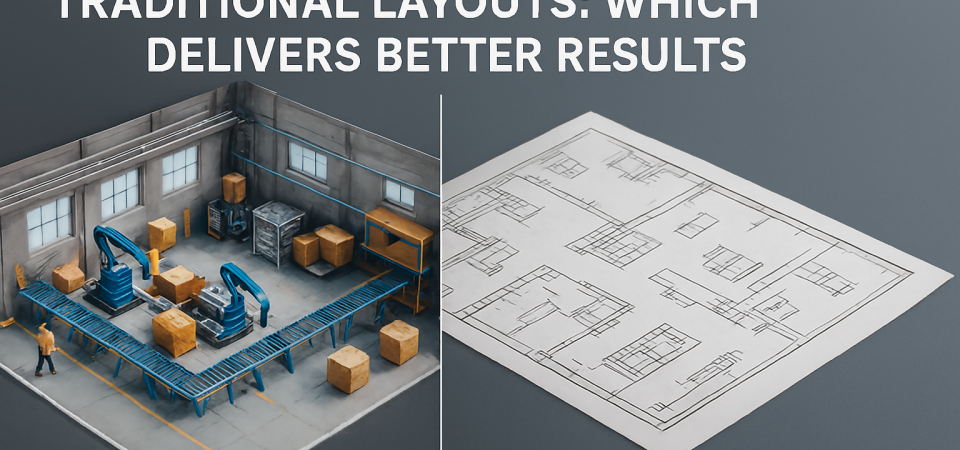
Plant layout planning is the backbone of manufacturing efficiency. Every decision — from machine placement to aisle width — impacts productivity, safety, and long‑term costs. Traditionally, companies relied on 2D layouts and CAD schematics to design facilities. While these methods are familiar and standardized, they often fall short in today’s complex, automated manufacturing environments.
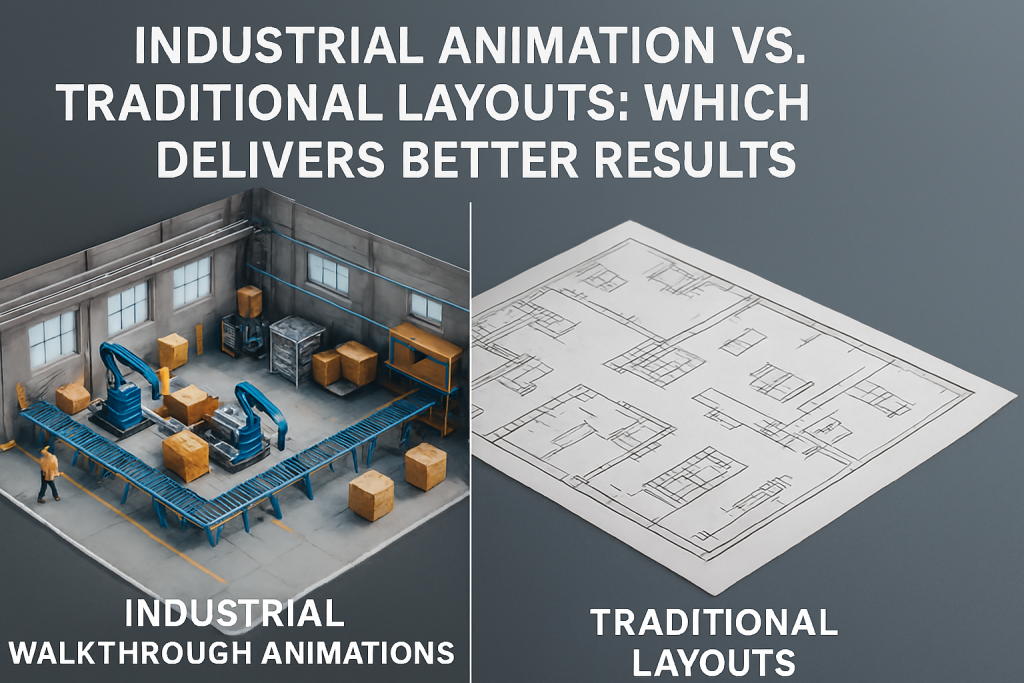
Industrial walkthrough animations are changing the game. These immersive 3D simulations allow stakeholders to experience the plant before construction, revealing inefficiencies and risks that static drawings simply cannot capture. Let’s explore in detail how the two approaches compare.
Traditional Layouts: Strengths and Limitations
Strengths
- Standardized documentation: CAD drawings and 2D layouts are universally accepted by engineers, architects, and regulators.
- Lower upfront cost: Producing basic layouts is relatively inexpensive compared to 3D animation.
- Quick drafting: Ideal for early conceptual planning or regulatory submissions.
Limitations
- Hard to interpret for non‑technical stakeholders: Managers, investors, and clients often struggle to visualize space from 2D drawings.
- Static representation: No simulation of material flow, worker movement, or safety hazards.
- Late error detection: Issues like bottlenecks or poor access points are often discovered only during construction.
- Limited collaboration: Requires expert explanation, slowing down approvals and cross‑functional decision‑making.
Industrial Walkthrough Animations: Strengths and Advantages
Strengths
- Immersive visualization: Stakeholders can “walk through” the plant virtually, making spatial understanding intuitive.
- Dynamic simulation: Animations show real‑time material flow, worker movement, and machine operation.
- Early error detection: Bottlenecks, safety hazards, and design flaws are spotted before construction begins.
- Cross‑functional collaboration: Engineers, managers, safety officers, and investors all see the same vision.
- Training and onboarding: Employees can familiarize themselves with layouts before the plant is operational.
- Marketing impact: Animations double as persuasive presentations for clients and investors.
Limitations
- Higher upfront investment: Requires specialized 3D modeling and animation expertise.
- Data dependency: Accuracy depends on detailed CAD inputs and engineering specifications.
Detailed Benefits of Industrial Animations
1. Workflow Optimization
Animations simulate material flow paths, worker movement, and machine‑to‑machine distances. This helps identify bottlenecks and optimize layouts for maximum throughput.
Example: An automotive plant reduced assembly line congestion by 20% after walkthrough simulations revealed inefficient workstation spacing.
2. Safety and Compliance
Animations visualize hazard zones, evacuation routes, and collision risks with forklifts or AGVs. This proactive approach reduces accidents and ensures compliance with OSHA and industry standards.
Example: A pharmaceutical facility used animations to redesign chemical storage areas, improve compliance, and reduce risk.
3. Cost Savings
Rework during construction can cost 10–30x more than changes made during planning. Animations validate designs early, avoiding costly redesigns.
Example: A food processing plant saved $1.2M in construction costs by identifying layout conflicts before execution.
4. Training and Onboarding
Animations prepare employees for equipment locations, SOPs, and emergency procedures before the plant is operational.
Example: A logistics company reduced onboarding time by 40% using walkthrough animations for warehouse training.
5. Marketing and Stakeholder Engagement
Animations double as client presentations, showcasing plant capabilities in a visually compelling way. This builds confidence and accelerates approval.
Example: A packaging manufacturer secured a major client contract by presenting a virtual plant tour instead of static drawings.
Conclusion
Traditional layouts remain useful for documentation, but they fall short in delivering clarity, collaboration, and efficiency. Industrial walkthrough animations deliver better results across every critical metric — from workflow optimization and safety to cost savings and stakeholder engagement.
Reality Premedia helps manufacturers bridge the gap between technical precision and visual storytelling. With expertise in 3D visualization, 3D Rendering, Industrial walkthrough, and AR/VR. We empower companies to plan smarter, communicate better, and build with confidence.


