
Introduction
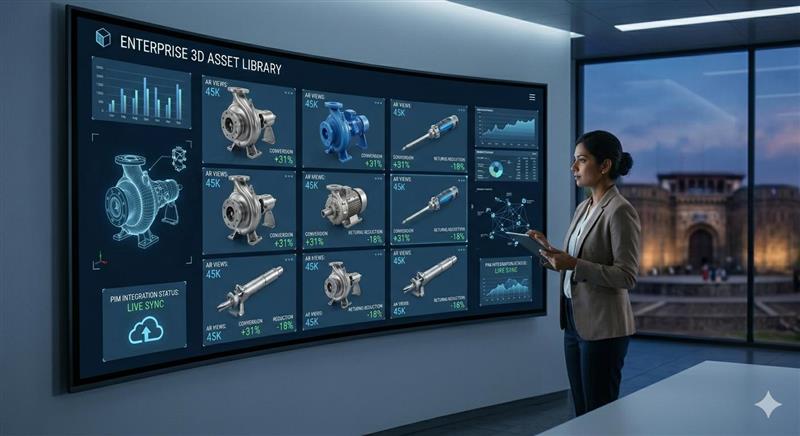
As digital commerce, virtual product experiences, and immersive marketing become enterprise mandates, 3D visualization is no longer a “nice‑to‑have.” For organizations managing hundreds—or thousands—of products, the challenge isn’t creating a single beautiful render. It’s building a repeatable, accurate, and scalable system capable of supporting high-volume CGI production at an enterprise scale.
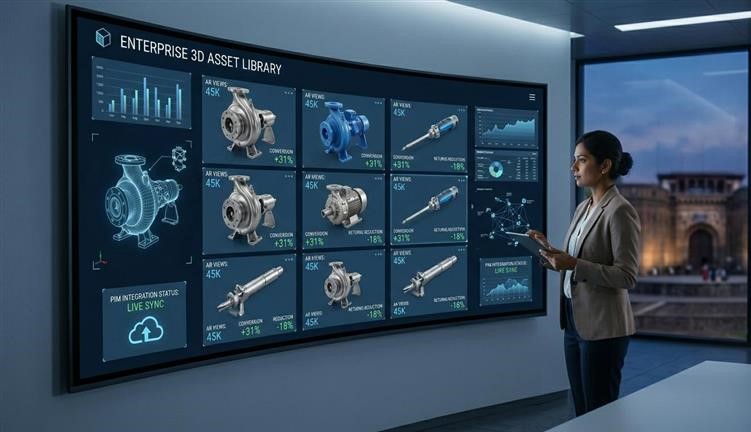
Many teams successfully visualize 10 or even 50 products. However, when the product catalog expands to 1,000, 5,000, or 10,000 SKUs, traditional creative workflows often break down. File inconsistencies multiply, accuracy errors slip through, and production timelines balloon. To succeed, enterprises need a robust Enterprise 3D asset pipeline—one that treats 3D as industrial infrastructure, not artisanal craft.
CAD to GLB/USDZ Conversion Services: The Foundation of Scale
For most manufacturers and enterprise brands, product truth already exists—in CAD. These files represent exact dimensions, tolerances, and materials used in production. However, raw CAD data is not suitable for real‑time web, mobile, or AR experiences.
This is where professional CAD to GLB/USDZ conversion services become critical.
Why CAD‑First Pipelines Matter
A CAD‑first approach ensures:
- Single source of truth across visualization, marketing, and ecommerce
- Elimination of manual remodeling errors
- Faster onboarding of large product catalogs
- Consistent geometry and materials across formats
Enterprise‑grade pipelines convert CAD formats (STEP, IGES, SolidWorks, Creo, CATIA) into optimized, platform‑ready assets:
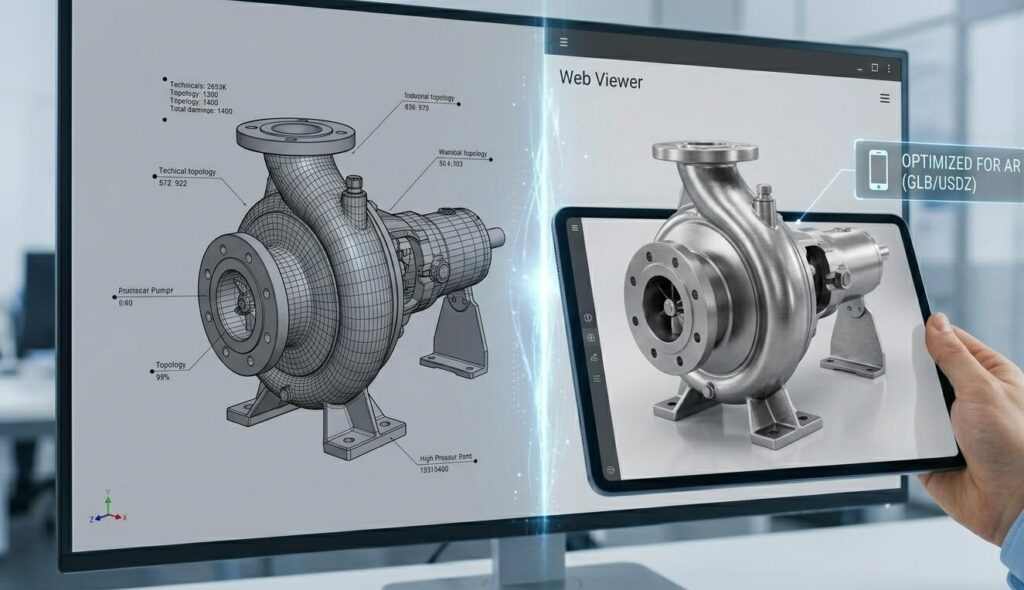
- GLB for web‑based 3D and configurators
- USDZ for iOS AR and immersive Apple experiences
Optimization Without Compromise
High-volume conversion is not a batch of export problems. It requires intelligent decimation, topology restructuring, and material translation that preserves visual fidelity while meeting performance budgets. Without this balance, SKU counts scale—but usability collapses.
A robust conversion strategy transforms CAD into reusable, modular 3D assets that can be leveraged downstream in marketing campaigns, product configurators, training tools, and digital twins.
Accuracy Is Non‑Negotiable at Enterprise Scale
When managing thousands of SKUs, even minor inaccuracies compound rapidly—and expensively.
An enterprise visualization error isn’t just a bad render:
- Incorrect dimensions affect AR placement.
- Wrong materials mislead customers.
- Inaccurate components disrupt configurators.
- Regulatory and compliance risks increase.
What “Accuracy” Actually Means
In high‑volume CGI production, accuracy spans multiple layers:
- Geometric fidelity: precise dimensions and tolerances
- Material correctness: color, reflectivity, texture scale
- Variant logic: correct combinations of options and components
- Metadata integrity: SKU IDs, names, and attributes aligned with PIM/PLM systems
Accuracy must be validated programmatically and visually using comparison checks against CAD, automated QA scripts, and human review gates for exceptions.
Trust Is the Output
At scale, accurate 3D assets become trusted enterprise data. Marketing, sales, engineering, and e-commerce teams can reuse them confidently without rework. That trust is what enables speed.
Scaling to 5,000 SKUs: From Production to Pipeline
The leap from 500 to 5,000 SKUs is not linear—it’s architectural.
Why Traditional Workflows Fail
Manual modeling teams and ad‑hoc vendors struggle because:
- Asset standards drift over time.
- Naming conventions break
- Multiple versions create confusion.
- Turnaround time scales exponentially
- Costs become unpredictable
The Enterprise 3D Asset Pipeline Model
A scalable Enterprise 3D asset pipeline behaves more like software infrastructure than a creative service. It includes:
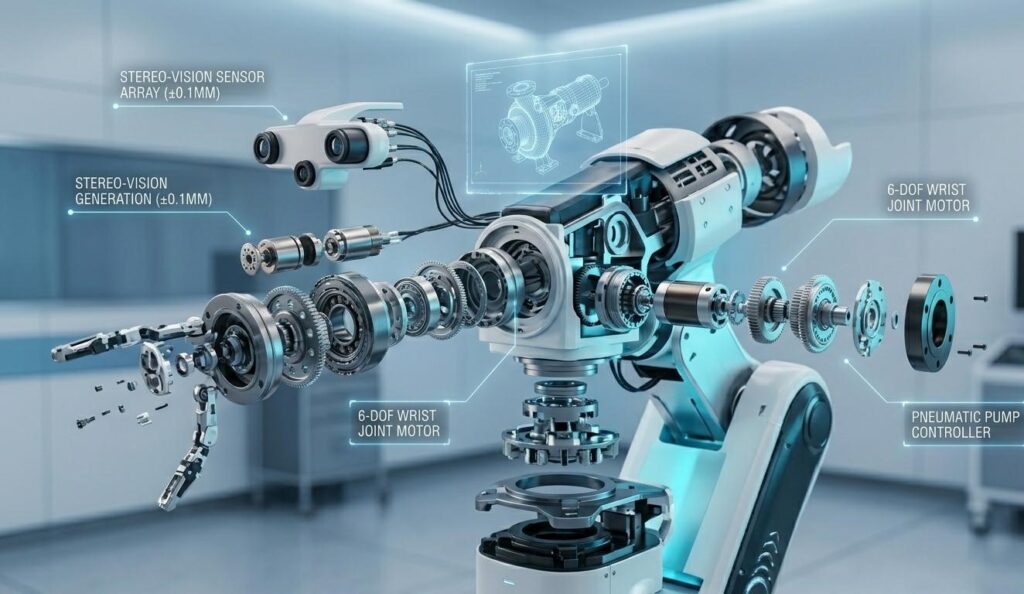
- Standardized Asset Specifications
Defined rules for polygon budgets, materials, LODs, naming, and delivery formats.
- Automation Wherever Possible
Scripted CAD imports, material mapping, export rules, and validation checks reduce human bottlenecks.
- Modular Product Logic
Shared components across SKUs (frames, handles, finishes) dramatically lower production volume through reuse.
- System Integration
Tight links with PLM, PIM, DAM, and CMS platforms to ensure asset updates propagate automatically.
- Scalable 3D Modeling Services
Human expertise remains essential—but applied surgically. Specialists handle edge cases, complex products, and new categories, while automation handles the rest.
The 5,000‑SKU Reality
Enterprises that succeed at this scale don’t “produce more assets.” They produce fewer unique parts and reuse them intelligently across thousands of SKUs.
Why Reality Premedia Matters in High-Volume CGI Production
When dealing with thousands of SKUs, even small discrepancies—slight color shifts, incorrect gloss levels, or unrealistic material behavior—can erode customer trust at scale. Reality premedia ensures that:
- Digital materials match real manufacturing finishes.
- Colors render correctly across lighting environments and devices.
- Textures correspond to physical surface behavior, not artistic interpretation.
- Components behave realistically in AR, 3D configurators, and real‑time viewers.
For global enterprises, this step reduces inconsistencies across regions, suppliers, and production batches.
Conclusion:
Scaling 3D visualization from 10 to 10,000 SKUs requires a fundamental shift in mindset. This is not about better renders—it’s about better systems.
By investing in:
- CAD‑first conversion workflows
- Accuracy‑driven QA processes
- A robust Enterprise 3D asset pipeline
- Proven scalable 3D modeling services
Enterprises can unlock true high-volume CGI production without sacrificing speed, accuracy, or control.


