
Introduction
The evolution of computer graphics has always been driven by the pursuit of realism. From early pixelated environments to today’s immersive virtual reality (VR) worlds, the demand for lifelike visuals continues to grow. At the heart of this transformation lies Generative Adversarial Networks (GANs), a breakthrough in artificial intelligence that reshapes how we create generative textures and render 3D scenes.
GANs are not just improving efficiency; they are redefining the creative process itself. By learning from massive datasets, these models generate textures and environments that rival reality, offering industries a new way to scale, innovate, and captivate audiences.
What Are Generative Textures?
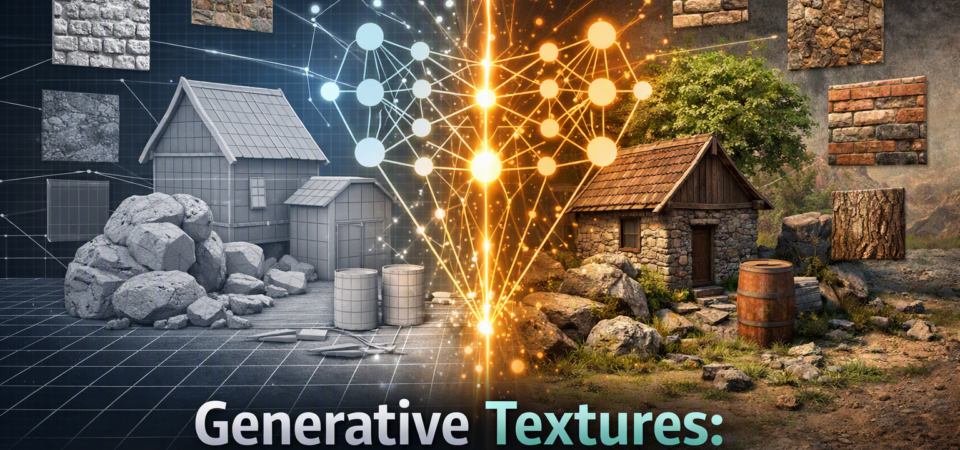
Generative textures are AI‑driven surface details that replicate the complexity of real‑world materials. Unlike procedural methods, which rely on mathematical rules, GANs use deep learning to synthesize textures that adapt dynamically to context.
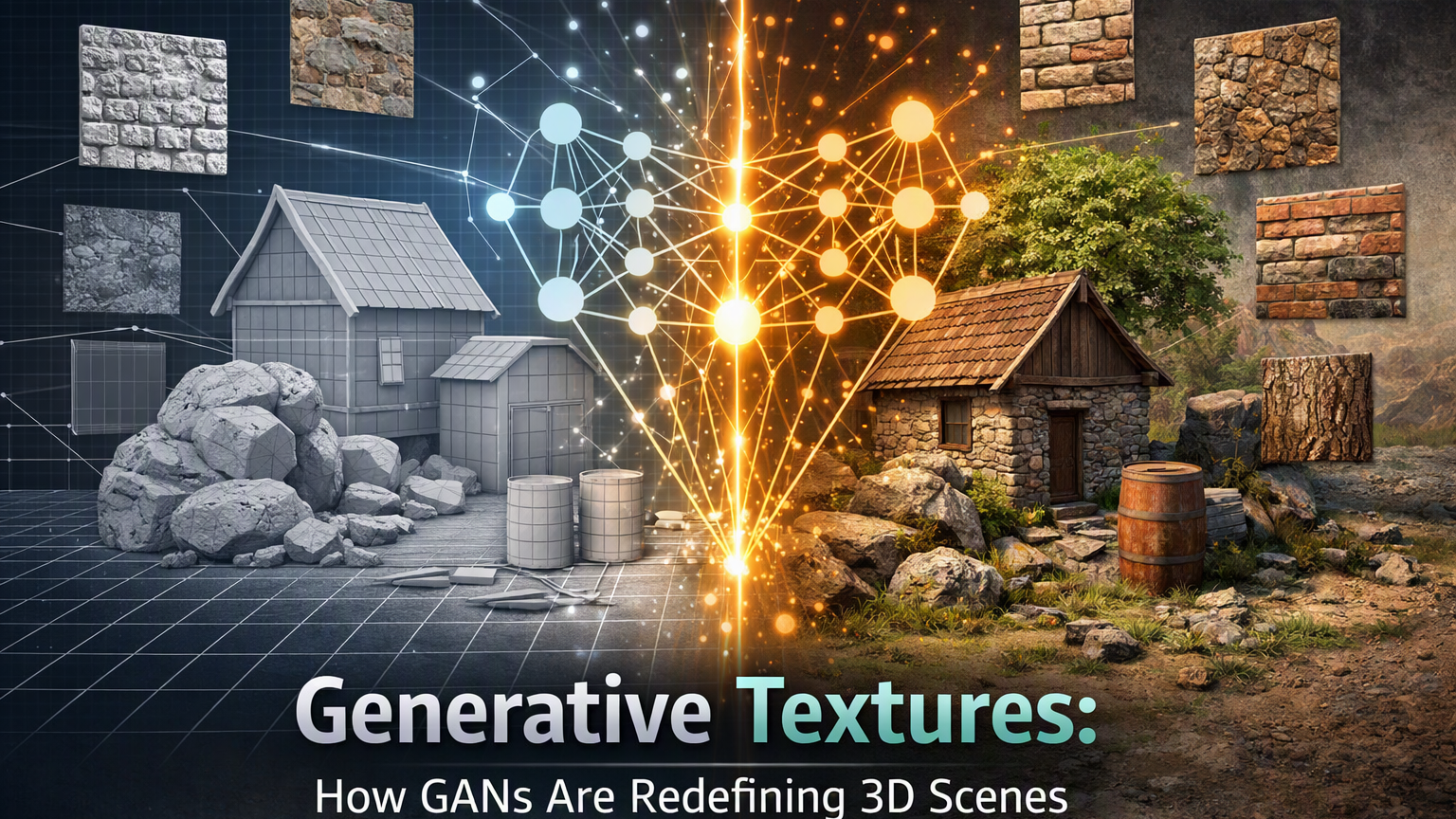
- Photorealistic replication: GANs can mimic intricate details such as fabric fibers, stone cracks, or metallic reflections.
- Adaptive rendering: Textures respond to changes in lighting, perspective, and environmental conditions.
- Automated scalability: Thousands of unique textures can be generated in minutes, reducing manual workload.
This innovation empowers designers to focus on storytelling while GANs handle the technical precision of realism.
How GANs Upscale Entire 3D Scenes
Traditional rendering pipelines often require multiple passes to refine low‑resolution environments. GANs streamline this by upscaling entire 3D scenes in a single process.
- Scene fidelity: GANs preserve geometry, lighting, and texture accuracy without distortion.
- Time efficiency: Rendering times are drastically reduced, enabling faster production cycles.
- Immersive storytelling: High‑quality visuals enhance audience engagement in VR, AR, and cinematic experiences.
This capability is particularly transformative in architectural visualization and film production, where presentation quality directly influences client decisions and audience impact.
Industry Applications of GAN‑Driven Textures
- Gaming: Realistic character skins, dynamic environments, and rapid asset creation.
- Architecture: Photorealistic interiors and exteriors for immersive client walkthroughs.
- E‑commerce: Lifelike product textures that boost consumer trust and conversion rates.
- Film and Animation: Upscaled cinematic scenes that save production time and costs.
- AR/VR: Seamless transitions across viewpoints for immersive experiences.
Technical Advantages of GANs in 3D Visualization
- Efficiency: Eliminates repeated rendering passes.
- Scalability: Handles thousands of assets simultaneously.
- Quality benchmarks: Superior performance in Frechet Inception Distance (FID), a benchmark for texture realism.
- Adaptability: Dynamic adjustment to lighting and camera angles.
- Cross‑platform integration: Compatibility with engines like Unity and Unreal for seamless workflows.
Challenges and Risks
Despite their promise, GANs face hurdles that must be addressed:
- Training instability: Sensitive to hyperparameters, requiring careful fine‑tuning.
- Data dependency: High‑quality datasets are essential; poor input leads to unrealistic outputs.
- Computational demand: Training GANs requires advanced GPUs and significant resources.
- Ethical concerns: Risk of misuse in creating deceptive or manipulated visuals.
Business Impact
For creative agencies, GANs enable faster project delivery, reduced costs, and higher fidelity visuals. In e‑commerce, lifelike product textures directly improve conversion rates and customer trust. For architects and filmmakers, GANs empower immersive storytelling with minimal manual intervention, positioning them as a cornerstone of next‑generation digital visualization.
Reality Premedia: Pioneering Hybrid AI in 3D Visualization
At the forefront of digital transformation in India, Reality Premedia is redefining how businesses leverage hybrid AI models for 3D visualization. By blending traditional rendering pipelines with AI‑driven generative techniques, the agency delivers immersive experiences that balance photorealism, scalability, and creative control.
Key Differentiators
- Hybrid AI workflows: Seamlessly integrate GANs, NeRFs, and explicit geometry for controllable yet realistic 3D assets.
- Immersive AR/VR experiences: Deploy hybrid rendering pipelines for trade shows, product launches, and interactive storytelling.
- Commerce‑ready assets: Validate textures and models for e‑commerce platforms, ensuring high conversion rates.
- Agency positioning: Establishes itself as India’s benchmark agency for 3D animation, AR/VR, and video production.
Business Impact
Reality Premedia’s adoption of hybrid AI models empowers clients to:
- Reduce rendering costs while maintaining visual fidelity.
- Accelerate project timelines with scalable AI‑driven asset generation.
- Enhance customer engagement through lifelike product visualization and immersive storytelling.
By combining technical precision with emotional resonance, Reality Premedia ensures that every project is not just visually stunning but also strategically impactful.
Conclusion
Generative Adversarial Networks are not just a technical innovation—they are creative enablers. By combining efficiency with photorealism, GANs redefine how industries visualize, design, and communicate. Their ability to produce generative textures and upscale 3D scenes positions them as a pivotal technology in the future of digital storytelling, immersive experiences, and business impact


