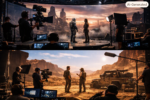
Introduction Rendering has long been the bottleneck of animation production. Hours of computation were required to achieve lifelike visuals. AI has shattered that barrier, enabling real‑time rendering with cinematic quality. For agencies, this means faster delivery, reduced costs, and limitless creative possibilities. Neural Rendering and Denoising AI‑based render engines like NVIDIA DLSS, Intel Open Image …read more
Alberto
AI and the Future of Storytelling in 3D Animation
Introduction Storytelling is the soul of animation. While visuals attract attention, it’s the narrative that builds emotional connection. AI is now stepping into this domain, helping creators craft stories that resonate deeply with audiences through data‑driven insights and emotional intelligence. AI in Pre‑Production AI tools like ScriptBook and ChatGPT‑based narrative engines analyze scripts for pacing, …read more
The Rise of AI in 3D Animation – Efficiency Meets Creativity
Introduction Artificial Intelligence (AI) has become the invisible engine driving the next revolution in 3D animation. What began as a tool for automating tedious tasks has evolved into a creative collaborator capable of learning, predicting, and even inspiring new forms of visual storytelling. For agencies and studios, AI is not just a technological upgrade—it’s a …read more
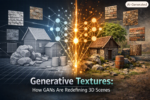
Generative Adversarial Networks Create Hyper‑Realistic Textures and Upscale Entire 3D Scenes
Introduction Generative Adversarial Networks (GANs) are revolutionizing 3D rendering, computer graphics, and digital visualization. By combining a generator that produces synthetic data with a discriminator that evaluates realism, GANs can deliver hyper‑realistic textures and upscale entire 3D scenes with unmatched precision. This breakthrough is transforming industries such as gaming, architecture visualization, film production, and e‑commerce, …read more
Artificial Intelligence in 3D Rendering: Faster, Smarter, and More Realistic
Introduction The demand for photorealistic 3D visuals has surged across industries such as architecture, gaming, film, and e-commerce. Traditional rendering methods, while powerful, often require extensive hardware resources and long processing times. Today, Artificial Intelligence in 3D rendering is transforming this landscape. By leveraging machine learning and advanced algorithms, AI enables faster workflows, hyper‑realistic textures, and scalable production pipelines that empower businesses …read more